Yesterday, I discussed a cause of action for a sports agent who loses a client based on another agent’s interference in his contractual relations with a client. As I assumed, the post has generated quite a bit of conversation on this site and also on social media sites like Twitter. Jay Reisinger, a partner at Farrell & Reisinger, LLC and a prominent sports attorney, sent some particularly interesting tweets in my direction. Here is one:
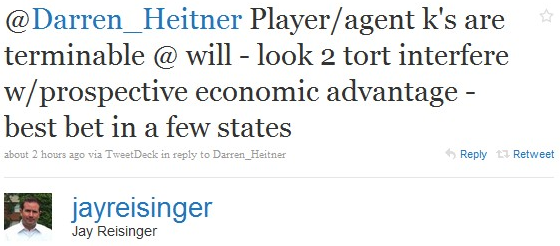
I can’t argue with the fact that there is solid precedent that player/agent contracts are terminable at will, but why does the type of a valid, enforceable contract (terminable at will contracts included) play any role in the quasi-intentional tort of interference with contractual relations? I posit that it does not. Additionally, the problem with looking to the tort of interference with prospective economic advantage is that with this tort, it seems more clear that it would not apply when the defendant is acting to benefit his own business interests. Personally, I believe that Reisinger’s concern about competition trumping an interference with contractual relations claim is misplaced, and instead should be placed with the interference with prospective economic advantage tort. Under this economic tort, a rival agent would likely be able to get away with entering into secret negotiations with the old agent’s clients and get away unscathed. But I understand where Reisinger is coming from. As he points out in another tweet, there is secondary authority (for trials outside the reach of Illinois law) when it comes to interference with contractual relations in the world of sports agency. Unfortunately, I think the court in that case ended up with a poor holding.
Let’s take a look at the case of Speakers of Sports, Inc. v. ProServ Inc., which was decided over 11 years ago in the U.S. 7th Circuit Court of Appeals. In that case, Speakers of Sport claimed that ProServ intentionally interfered with its contractual relations with Ivan Rodriguez by inviting Rodriguez to ProServ’s office and promising Rogriguez a certain amount of money in endorsements. Summary judgment was granted to ProServ by the Trial Court and affirmed by the Circuit Court. It looked like the Circuit Court might get it right when it said,
inducing the termination of a contract, even when the termination is not a breach because the contract is terminable at will, can still be actionable under the tort law of Illinois, either as an interference with prospective economic advantage, or as an interference with the contract at will itself.
But it went on to say,
Competition is not a tort, but on the contrary provides a defense (the “competitor’s privilege”) to the tort of improper interference. It does not privilege inducing a breach of contract, but it does privilege inducing the lawful termination of a contract that is terminable at will. Sellers (including agents, who are sellers of services) do not “own” their customers, at least not without a contract with them that is not terminable at will.
Why does it matter that the contract is terminable at will? Both are contracts, and both are being terminated based on an inducement by a third party. And what if the agent has a contract with a client that stipulates that the contract is not terminable at will? Or are all principal/agent contracts terminable at will no matter what is written within the 4 corners of the written document?
One important point about the case is that its dicta says that it should be okay for an agent to promise the client of another agent that he could do better for the client. But what about making comments about the incapacity or inability of the client’s old agent while the old agent is still the representative of record?
The Court seems to be very concerned that competition will be severely limited should an agent have a leg to stand on in a claim of interference in his contractual relations with a client. Really, though? This is one of the most competitive industries whether or not the claim exists. If I no longer have the ability to try to pry away a competitors client, that I know to be a competitor’s client, am I that severely limited in my trade?
I disagree with the Court when it says,
Worse, the established standards of a trade or profession in regard to competition, and its ideas of unethical competitive conduct, are likely to reflect a desire to limit competition for reasons related to the self-interest of the trade or profession rather than to the welfare of its customers or clients.
You don’t think athletes will benefit from a legitimate scare tactic available to be used against unscrupulous agents who will say anything to a client under contract in order to make him one of “his own”? Athletes have a lot to gain. If they are unhappy with their agent, they hear other players talking about how good their agents are, etc, they have no restraint in breaking their agency contract and finding a new agent. Why then does the Court find it so necessary that agents need also be allowed to interfere and potentially break up good relationships, which may end up causing harm to the athlete in the long run?

7 replies on “Digging Deeper Into The Contractual Interference Claim”
Darren, it’s really great to see how passionate you are about a lot of the things in this industry. I was watching this play out on twitter yesterday and I’m very glad you did a follow up post on the blog.
You know I’m a big fan of yours as well. GOAL USA!!!!!!!!!!!!!!!!!!!!!!!
I thought all player/agent contracts are required to be terminable under the CBAs of the major leagues? And because of that, in the leagues where its not required, the free market forces agents to make them terminable as well… I could be wrong (wont be the first or last), but I thought I read that back when I was reading CBAs…
Regardless, as much as it pains me to say, I think the court in Illinois got it right…
We know how this business is, if we (thinking in the most righteous way) think this is a shield for good agents whose clients may be getting sold pie in the sky, there are just as many shady agents who see this as a sword in case a client leaves for a competitor. Courts would be clogged with angry agents attempting some “get back” for losing a client — whether it was due to their incompetence or otherwise.
Think about it — you dont think a clever agent would find some way to even try to sue ATHLETES for talking up how good their agent is? What if the athlete is complaining about his agent and his teammate says, “you should sign with my guy… he’s good.” Thats an inducement, right?
Further, I think the key component is the termination at will provision inherent in most professional sports player-agent contracts. The interference claim is connected to influencing a party to BREACH. If a client can leave when they want, they can choose to leave for any reason — maybe because they dont like your new haircut… Therefore it follows that any outside force (save for coercion) is allowable.
If we believe in a free market, we have to hope that clients, once they dont get that pie in the sky will return to their proper agents… I know that athletes (and agents) stand to lose heaps of money in the process, but their decisions are their decisions – and the consequences of said decisions are the consequences. I think we can only do our best, and hopefully our reputations can insulate us from some of the damage.
Not all contracts are bound by CBAs. Aroldis Chapman had to have been signed to a contract with Mejia prior to switching to Hendricks. At that point in time, he was not yet signed by a professional team. Thus, no player contract, and no binding by the CBA.
Worried about courts getting clogged? Make it an arbitration issue.
If an athlete is complaining and another athlete recommends his agent, no, I would not consider that to be interference in contractual relations. The upset athlete is shopping…no problems there.
A client better not leave me because of my haircut – those spikes are tough to procure.
what about a parent, during the “advisory process”, relies on you to help their son (thru the mlb draft)…..than, once the kid is drafted, the parents decide they won’t use your services and handle it themselves? They feel that they sucked enough info from you and your agency, wanting to do it on their own to “save $ for their kid”…..
All that time you spent on that child, etc…..down the drain. Isn’t that the same thing you’re talking about? It may not be another agent, but it still is interference of contractual items, correct? Or is it nill because “nothing is signed”?
It’s definitely not a good feeling, but that wouldn’t be an interference with contractual relations if no one caused the parent/child to breach the contract. Instead, you would be looking at a potential breach of contract claim. Nothing need be signed. You could have an implied-in-fact contract. See: https://sportsagentblog.com/2010/05/10/protections-for-baseball-advisors/
[…] relations? If you need a refresher, see: Sports Agents Interfering With Contractual Relations, Digging Deeper Into The Contractual Interference Claim, and The Interference With Contractual Relations Conversation Continues. In those posts, I looked […]